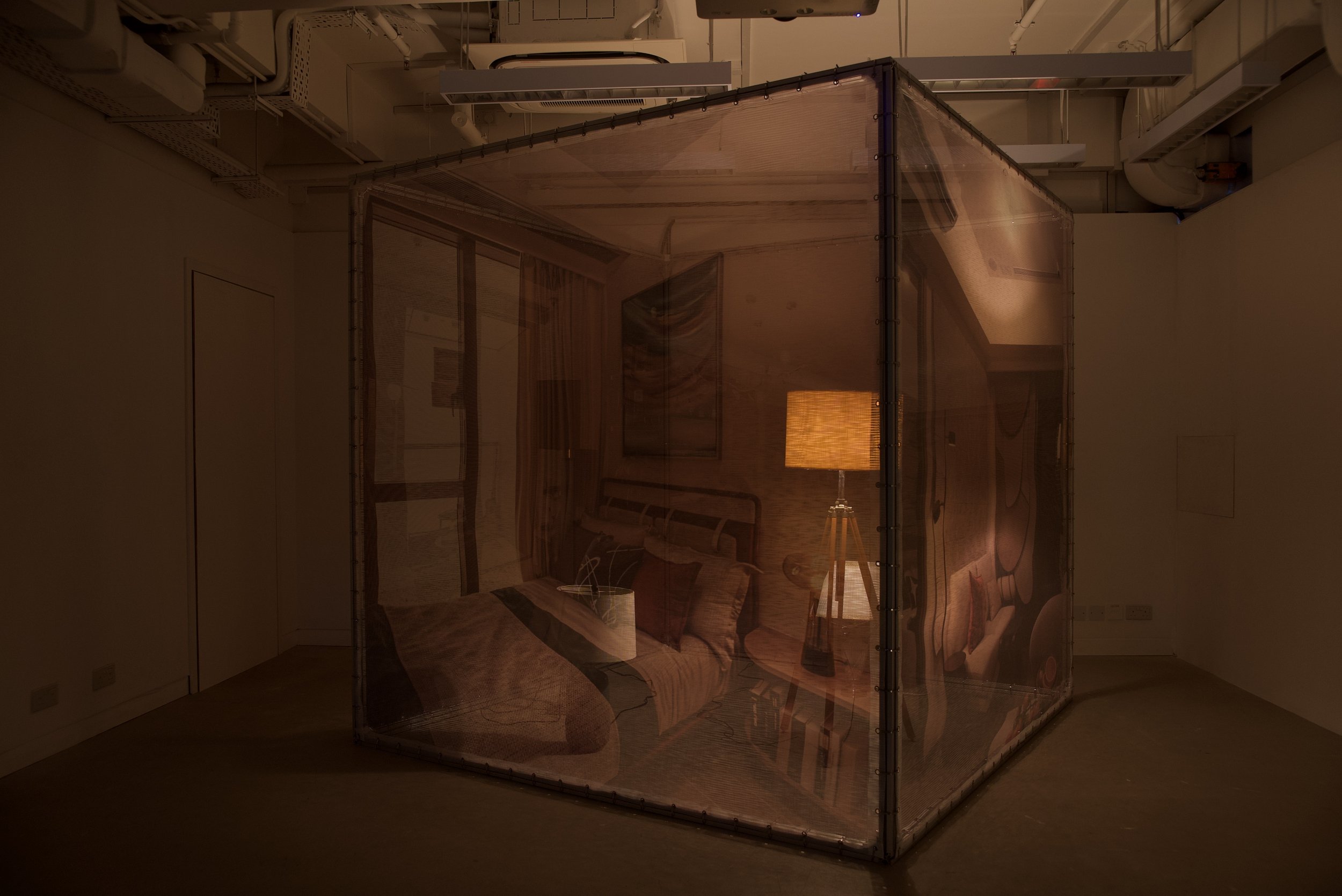
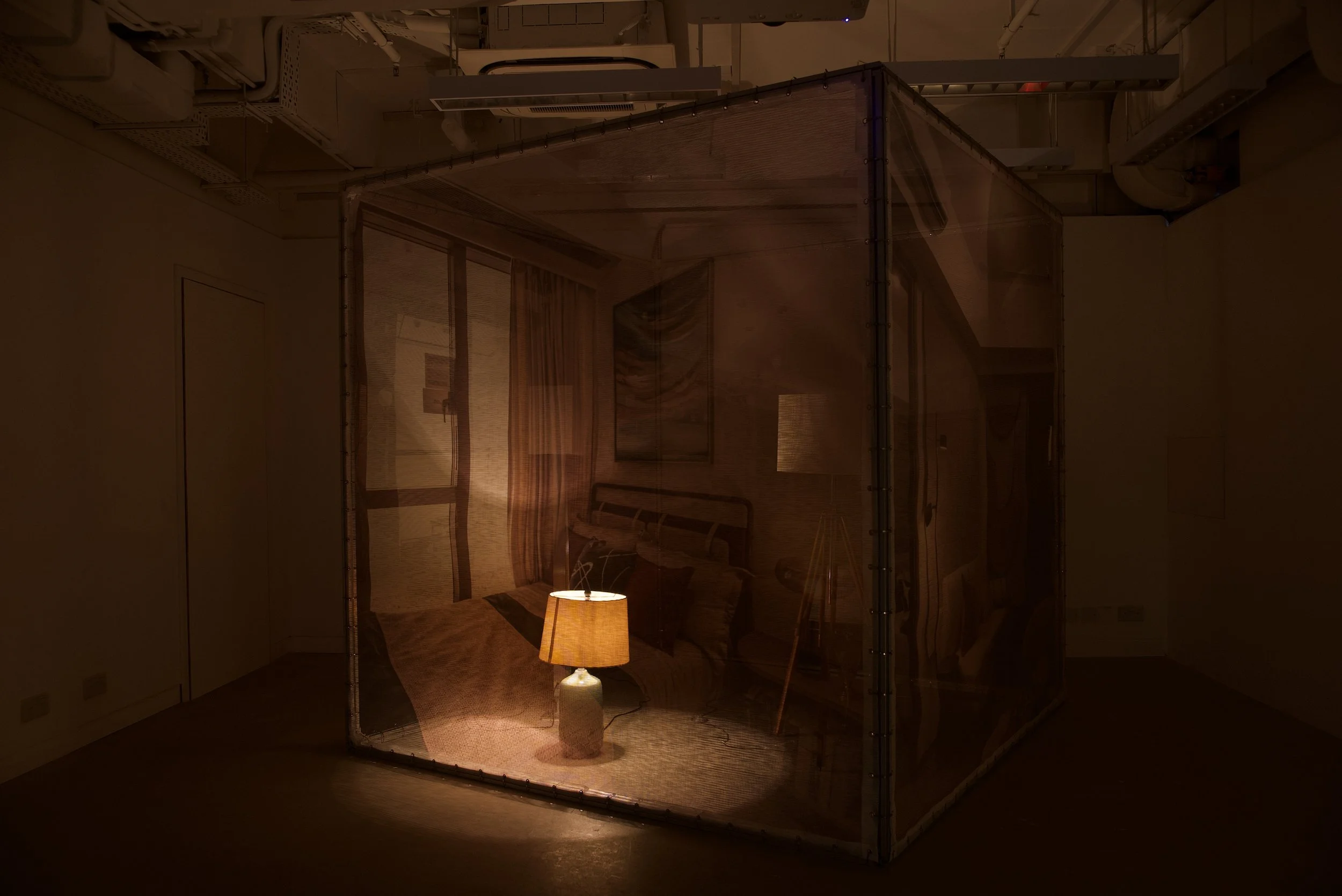
繁星 Stars
2025
噴墨廣告海報、二手燈具、鋁型材、電腦程式
Printed banners, secondhand lamps, aluminum profile, digital programme
棲居在溫柔點的夜裏
To reside in the tenderness of the night
-
“Drop Me Off at the Rear”: The Reorientation in Displacement
art writing by Eilly Li @by.eillyli
“Distance” and “displacement” are often conflated, but they are fundamentally distinguished concepts. While “distance” refers to the total length of the path between any two points, omitting specific direction, “displacement” denotes the shortest route from origin to destination, a vector rather than a trace, specifically stressed on the direction. Therefore, the presence of “displacement” assumes intention and directionality, which indicates an origin that is not only spatial but more often psychological. In Sigmund Freud’s psychoanalytic theory, “displacement” is an unconscious defence mechanism in which the mind redirects either a new goal or a new object for things that are perceived as dangerous or unacceptable in their original form. However, rather than accepting such detours as compromises, what if we consider them as sites of potential orientation, an active choice for recalibration instead of avoidance? In this sense, the atypical request to “Drop Me Off at the Rear” implies the assumption that the passenger has a known destination, even if the route is unconventional. Displacement is not always chosen – a stop might be missed due to a moment of inattentiveness, or an intentional silent rebellion against habitual circuit under external pressure. Graduates this year seemingly acknowledged the need to recover one’s trajectory, to reclaim a sense of direction and reorient in displacement.[…]
Echoing with the radiant suitcase, Aidan Ng’s Stars, an installation consisting of temporarily framed printed canvases and second-hand lights, reflects on the impermanence of home and hope. Almost simulating a display unit, the cubic installation constructs an idealised image of home, both tangible and illusory. The affirmation and negation of reality and illusion invite viewers to immerse themselves in a sense of ethereality. The rhythmic flickering of the lights becomes central to the emotional cadence of the work, pulsing like sparks of hope amid uncertainty.However, it also foreshadows their eventual vanishment. It shows an attempt to hold onto constancy and hope amid uncertainties in life, even though that moment of solace might flicker and fade, and eventually be engulfed in the darkness of reality. Aidan constructs a space that captures this fragile emotional state, inviting viewers to “reside in the tenderness of the night,’ where ephemerality becomes a kind of truth that guides us in times of displacement.
The request to be dropped off at the rear disrupts societal behavioural norms, acting as a quiet defiance against prescribed routes and structured expectations. In many of this year’s graduate works, traces of nostalgia and a desire to reclaim one’s roots are obvious. “Home,” as both a metaphor and memory, is a solid ground amid turbulence and in-betweenness. The ambiguity presented in these liminal spaces perhaps unveils a mixed feeling, in which longing is intertwined with uncertainty, and hope is laced with fragility. Once the concept of time is not moving forward in a linear track, and the depiction of space is not extending in a singular direction, the very definition of existence begins to shift, becoming a condition shaped not by societal norms and conventional rules that determine direction and destinations.